The Road to Consecration: Lodge St. Olaf’s New Temple, 1965–1969
On Friday, 19th December 1969, brethren from across Aberdeenshire East and beyond gathered in Cruden Bay for a landmark occasion in the history of Lodge St. Olaf – the Consecration of its new Lodge rooms.
The ceremony marked the culmination of fifty years of progress for the Lodge. Since its founding in 1919, Lodge St. Olaf had conducted its meetings in Port Erroll Public Hall. While the arrangement had served the brethren well for half a century, the acquisition of dedicated Lodge premises represented a significant step forward and was viewed with great pride and enthusiasm by the members.
The occasion attracted a large attendance, reflecting both the importance of the event and the esteem in which Lodge St. Olaf was held throughout the Province. The Right Worshipful Master, Bro. James Love, welcomed a distinguished deputation from The Provincial Grand Lodge of Aberdeenshire East, led by the Right Worshipful Provincial Grand Master, Bro. C. S. Henderson.
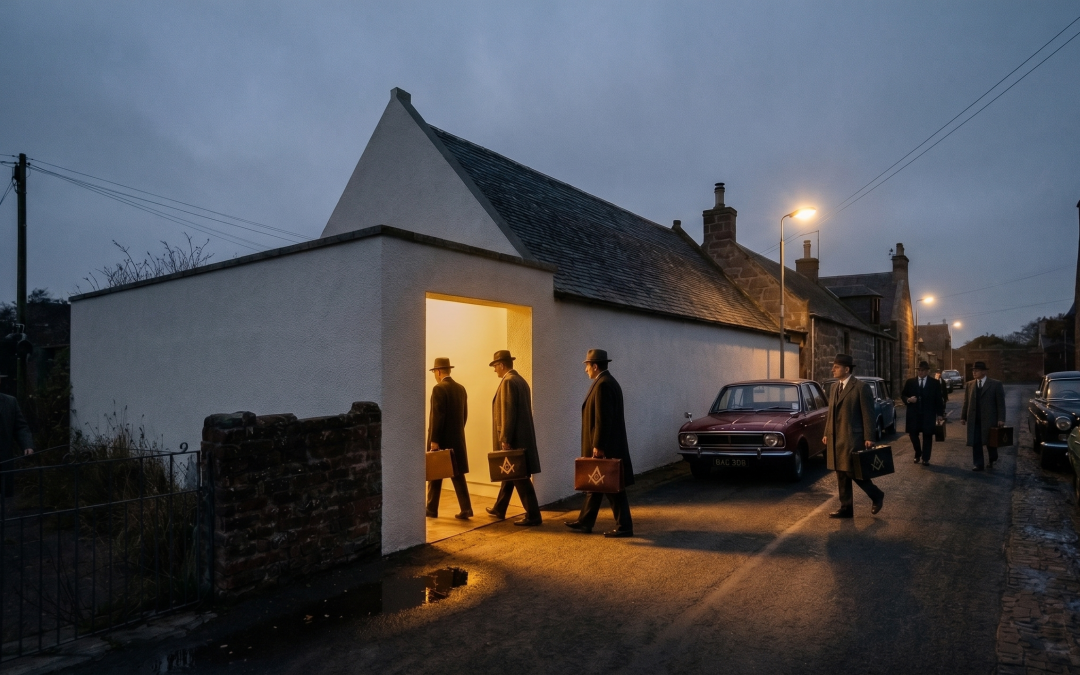
The Lodge was tyled at 7:30 p.m., with the new Lodge room filled to capacity for the proceedings. Given the time of year – the final weekend before Christmas – many of those attending would have travelled considerable distances through the winter darkness to be present in Cruden Bay. In December 1969, journeys across the north-east of Scotland were far less straightforward than they are today, with brethren making their way along narrow country roads from all parts of the Province to support Lodge St. Olaf on this historic evening. Despite the season and the demands of travel at that time of year, the attendance demonstrated the strong fraternal bonds that existed throughout Aberdeenshire East and beyond.
The Consecration Ceremony itself was conducted by the Provincial Grand Lodge of Aberdeenshire East under the direction of Bro. C. S. Henderson, Provincial Grand Master. The proceedings combined solemnity, symbolism, and celebration, formally dedicating the new Lodge room for Masonic purposes and marking the fulfilment of a long-held ambition of the brethren of Lodge St. Olaf.
A full contemporary account of the Consecration proceedings is reproduced later in this article from the official minutes of the evening. That record preserves many of the ceremonial details, the remarks delivered during the proceedings, and the acknowledgements made to those whose efforts helped bring the project to completion.
For the brethren of Lodge St. Olaf, however, the evening represented far more than the opening of a new building. It marked the beginning of a new chapter in the Lodge’s history – one in which future generations of members would meet within premises they could truly call their own.
Yet the successful consecration of the new Lodge rooms had been several years in the making. The Lodge minutes from the period between 1965 and 1969 reveal the determination, careful planning, financial sacrifice, and practical effort undertaken by the brethren in order to achieve their ambition.
16th December 1965
The earliest recorded reference to the proposed new temple appears in the minutes of this meeting, with Fred Warrander presiding in the chair. The minute records:
“The remainder of the evening was spent on a general discussion regarding the raising of funds for the temples funds.”
Although brief, the entry marks the beginning of a sustained campaign to secure dedicated premises for the Lodge.
24th March 1966
A major step forward came when the Lodge received communication from their solicitor regarding a prospective property purchase:
“A letter from Mr. J. A. S. Glennie, solicitor was submitted informing that the Directors of F Simmers Ltd. had accepted in principle our offer of £100 for the building known as ‘Old Stables’ The Bakery Cruden Bay, plus 2 pieces of ground attached. A scetch will be submitted later when the bounderies could then be defined.”
For the first time, the possibility of acquiring a permanent home for the Lodge became tangible.
20th October 1966
Further legal correspondence concerning the purchase was discussed:
“A letter from Mr. A.S. Glennie, solicitor, regarding the purchase of the property belonging to messers F Simmers Ltd. and after some discussion it was agreed to defer a final decision until the next meeting.”
The brethren clearly wished to proceed cautiously before finalising the transaction.
3rd November 1966
At the following meeting, the matter reached a decisive point. The minutes record:
“A letter with 2 ammendments to the draft disposition regarding the purchase of the property belonging to Messers F Simmers Ltd. was submitted. After a full discussion proposed by Bro. E Daniel seconded by P.M. N Park, that the Lodge agree to purchase the property.”
The Right Worshipful Master, Bro. F. C. Thorne, requested that his concerns be formally noted:
“Bro. F. C. Thorne R.W.M. asked that his dissent to the finding be recorded – owing to the fact that access to the ground on the south side was not defined on the plan.”
Despite this reservation, the project moved forward, and the Lodge formally established oversight of the development:
“The R.W.M. proposed and P.M. E Daniel seconded that the Lodge Management Committee be appointed as the Temple Building Committee.”
25th January 1968
Attention had by now turned to architectural planning and design:
“A letter and new plans for the Temple was submitted from Mr F.S. Stephen in which he suggested again that he should attend a meeting to explain the various aspects of the work involved.”
The project was steadily taking shape.
24th October 1968
The revised plans were discussed in greater detail later that year:
“All present were in favour of the new temple plans but felt that the final decision should be postponed for the next meeting when more office bearers will be present.”
The Lodge sought broad agreement before proceeding further.
14th November 1968
Practical aspects of the construction work now occupied the attention of the brethren:
“P.M. Bro. H Bremner enquired whether steps had been taken to purchase the Rentokill for the timbers of the proposed new temple.”
The minute continues:
“It was reported that R Gray joiner had offered to supply 2 gallons at a reasonable rate and Bro. Daniel reported that he had received an offer of assistance in levelling the floor of the lodge.”
These entries reveal the extent to which members and local tradesmen contributed directly to the building effort.
9th January 1969
By early 1969, planning approval was imminent:
“In reply to a suggestion by Bro. C Fyffe regarding the progress of the plans for the new temple, it was reported that they were due to be presented for planning permission on the 10th January 1969.”
6th February 1969
The following month confirmed the formal submission of the plans:
“It was reported to the meeting that planning permission had been submitted with the plans for the Lodge.”
20th February 1969
Financial prudence remained a constant consideration throughout the project:
“An account of £53:18/6d from Frank Stephen for preparing plans of the proposed temple was discussed, and it was remitted to P.M. Bro. F Thorne to contact Mr. Stephen in an attempt to have the account reduced.”
3rd April 1969
Construction materials were now actively being sourced:
“P.M. Bro. Park reported the several 7′ x 22′ timber sections, suitable for use in the new Temple were available at a cost of £5 per section and it was agreed to buy 4 sections.”
10th April 1969
As work progressed, practical authority was delegated to ensure momentum continued:
“In order that work could proceed with the new Lodge it was agreed that Brother E Daniel be authorised to purchase such small items as he needed.”
2nd October 1969
By autumn 1969, significant progress had clearly been made:
“Bro. E Daniel reported on the progress being made with the new temple and a general discussion followed.”
The minutes further record:
“Building accounts for £270 and £88/4/- were submitted and it was proposed by Bro. Bremner and seconded by Bro. Park and agreed unanimously that they be passed for payment.”
16th October 1969
Only weeks later, finances and progress were again reviewed:
“Progress on the new lodge was discussed and the Immediate Past Master Bro. Thorne reported that the funds at our disposal were now approximately £170.”
30th October 1969
Attention had now turned to finishing touches within the building:
“A general discussion was had regarding the new lodge and approval was given for the purchase of wallpaper.”
27th November 1969
With completion approaching, arrangements for the Consecration Ceremony were formally discussed:
“On Friday 19th December 1969 if this date was acceptable to Provincial Grand Lodge. It was remitted that the Secretary to contact the Provincial Grand Secretary, and if date was acceptable, to notify Lodge secretaries, and to arrange for a press advertisement.”
Plans for the evening’s celebrations were also put in place:
“It was also agreed that the ceremony be followed by a Dinner and Harmony in The Kilmarnock Arms Hotel, and a deputation was appointed to contact Mr. Carmichael to make the preliminary arrangements.”
11th December 1969
The final meeting before the Consecration carried a particular poignancy. The minutes record:
“As this was the last meeting to be held in the Public Hall, the Secretary was instructed to mark the occasion and to write to the secretary of the Public Hall Committee expressing the appreciation of the members for the facilities which had been offered them over so many years.”
After fifty years within the Public Hall, the brethren prepared to leave behind the premises that had served generations of members since the Lodge’s foundation in 1919.
19th December 1969
Report on
Consecration
of the
New Lodge Room
of Lodge St. Olaf No. 1188, Cruden Bay
by
The Provincial Grand Lodge of Aberdeenshire East
By C L Henderson M.A. B.Sc. C.P.
Right Worshipful Provincial Grand Master Presiding
on
Friday 19th December, 1969, at 7:30 p.m.
The office bearers and brethren of Lodge St. Olaf were joined by 70 representatives from 14 Lodges to welcome the Office Bearers of Provincial Grand Lodge, led by Bro. C. S. Henderson, R.W.P.G.M., who were piped into the Lodge by Bro. A. Donaldson of Lodge St. James No. 256, Peterhead.
The Provincial Grand Master opened Provincial Grand Lodge in the First Degree, passed it to the Second, and raised it to the Third Degree.
Following prayers offered by the Provincial Grand Chaplain, Bro. Nicholson, and the singing of the Consecration Hymn, the Provincial Grand Master delivered a presentation on the Nature and Objects of Freemasonry and reminded the meeting of the constant need to practise universal benevolence.
The office bearers of Provincial Grand Lodge then perambulated the Lodge, scattering corn in the South, pouring wine in the West, and oil in the East, using aerosols kindly loaned by Lodge Scone No. 3, Perthshire. Included in the ceremony was a magnificent cornucopia formed from the horn of a Highland steer killed at Taymouth Castle to celebrate a Royal visit. The horn was subsequently ornamented in silver and presented to the Perthshire Lodge in 1841.
At the conclusion of the ceremony, Bro. J. Love, R.W.M. of Lodge St. Olaf, thanked Bro. Henderson and his fellow Provincial Office Bearers. The occasion, he said, marked the realisation of a 50-year wish by the brethren of St. Olaf, who for half a century had conducted their meetings in the local Public Hall.
The new premises, formerly a stable and cart shed, had been acquired two years previously, and the reconstruction work had been carried out by Mr. Ian Noble of Peterhead, assisted by Lodge members. Thanks to generous gifts of money, furnishings, and labour, it was anticipated that the final cost would not exceed £1,500.
Attention was drawn to the curved dais of the platform which, together with some of the seating, had formerly been part of the furnishings of the old Chriche Church at Stuartfield.
Brother James Love then introduced two founder members: Past Master Bro. A. Cordiner of Cruden Bay, and Past Master Bro. S. Sinclair of Longhaven, who was then 91 years of age. These two brethren, he explained, had been largely responsible for keeping Lodge St. Olaf in existence during the Second World War and were representative of the men who had worked and saved for so many years to bring the Lodge into being.
The Right Worshipful Master acknowledged the thanks due to the many people who had contributed to the new building, but wished to pay particular tribute to Past Master Bro. E. Daniel for his magnificent personal service in helping to bring the new temple into being. He therefore asked the Provincial Grand Master to present Past Master Bro. Daniel with a wristwatch as a small token of the appreciation of his Lodge brethren.
Past Master Bro. W. Gordon of Lodge Keith No. 56, speaking on behalf of the visiting Lodges, congratulated Lodge St. Olaf on their achievement. He reminded the assembly of the events in another stable not so many years ago which had such an influence upon the world, and expressed the hope that, from its former stable, Lodge St. Olaf would continue to have an influence for the good of Freemasonry in East Aberdeen.
There being no further business, the Special Meeting of Provincial Grand Lodge was, by command of the Right Worshipful Provincial Grand Master, closed in due and ancient form.
The Consecration of the new Lodge rooms on 19th December 1969 therefore represented far more than the opening of a building. It was the successful conclusion of years of fundraising, negotiation, planning, and voluntary labour undertaken by devoted brethren determined to provide Lodge St. Olaf with a permanent home of its own.
The minutes from those years preserve not only the practical details of the project, but also the spirit of cooperation, perseverance, and fraternity that made the achievement possible. More than half a century later, they remain a testament to the dedication of the brethren whose efforts shaped an important chapter in the history of Lodge St. Olaf, Cruden Bay.
Investment Summary
Back in 1969, an old stable in the centre of Cruden Bay was bought for just £100. A further £1,400 was spent converting and renovating the building into a Masonic Lodge — bringing the total investment at the time to £1,500.
Adjusted for inflation alone, that £1,500 outlay in 1969 would equate to roughly £32,000–£34,000 in 2026 money. But the real story goes far beyond inflation.
When the project began, northeast Scotland had not yet experienced the huge economic transformation brought by the North Sea oil industry. Over the decades that followed, rising prosperity, housing demand, and property scarcity dramatically increased land and building values across Aberdeenshire — including villages like Cruden Bay.
What was once a neglected stone stable bought for £100 would today likely represent a substantial investment project: a similar central village building could now cost well into six figures to purchase,
with renovation and conversion costs potentially adding hundreds of thousands more.
To recreate the same type of project in 2026 — purchasing and converting a historic outbuilding in the heart of the village — could realistically require an investment of £250,000 or more.
It’s a remarkable example of how timing, vision, and local history can shape long-term value.
A £100 stable purchased before the oil era arrived in Aberdeenshire became more than just a building conversion — it became part of the changing story of northeast Scotland itself.
The Detail
A simple inflation adjustment (£100 purchase + £1,400 renovation in 1969) only tells part of the story. A stable in the centre of Cruden Bay would also have benefited from:
- the North Sea oil boom from the 1970s onward,rising commuter demand for the Aberdeen area, scarcity of central village property, tourism and golf demand, and the conversion premium attached to unusual historic buildings.
- Cruden Bay itself was specifically “reinvigorated as a commuting settlement with the oil boom.” So the economics of “doing the same project today” are very different from merely adjusting for inflation.
Rough reconstruction of the original project
Purchase price: £100
Renovation: about £1,400
Total invested circa 1969: £1,500
Pure inflation adjustment to 2026: £1,500 in 1969 ≈ £34,000 today, but that ignores land and property appreciation. What would the equivalent project likely cost today? For a centrally located old stable in Cruden Bay today, a realistic modern equivalent could look something like:
Component Likely 2026 Cost
Purchase of derelict stone stable/building £80k–£180k
Structural renovation/conversion £120k–£300k+
Planning/building compliance £10k–£30k
Total likely investment £210k–£500k+
That huge jump is because:
- Land values rose far faster than inflation, labour/materials became vastly more expensive, and central village plots became scarce and desirable.
- Current average Cruden Bay property values are around £190k overall, with many detached properties selling well above £250k.
The oil industry effect
The North Sea oil era transformed northeast Scotland property markets from the 1970s onward. Aberdeen and surrounding commuter settlements saw decades of inflated housing demand tied to high-paying energy jobs. Even though the market cooled after the 2014 oil downturn, the long-term uplift compared with 1969 is still enormous. So that £100 stable purchase before the oil boom was exceptionally well timed.
A realistic modern comparison
If someone attempted the exact same type of opportunity today: Finding a neglected stone outbuilding in the dead centre of Cruden Bay would itself be difficult, the land alone could easily cost more than the entire original 1969 project adjusted for inflation, and the completed property might ultimately be worth somewhere in excess of £250k, depending on size, finish, sea views, and holiday-let potential.
So in practical terms: Inflation-only equivalent: = £34k. Real-world property-market equivalent: probably a quarter-million pounds or more, that shows how much of the gain came not from inflation, but from: property scarcity,, oil-economy expansion, and long-term land appreciation in coastal Aberdeenshire.